 |
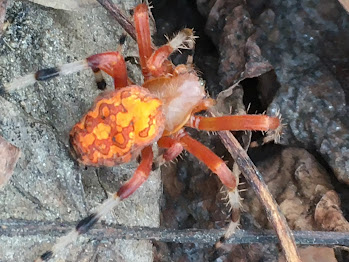
The florescent orange, highly venomous Araneus marmoreus
orb-weaver trekking across the Blue Ridge Parkway
on High Swan, late November, 2022. |
Humans are most alive and joyful, truly joyful, when at home in their
natural state of wildness. Why is
that? Wildness sparks with us a deep
survival instinct that heightens our senses, increases our strength and pain
tolerance, and gives us an immediate sense of purpose. Beyond that, it compels us to experience our
connection with the wide universe.
We are, however, separated from wildness by the protections
and aids of what we call civilization.
Civilization is valuable and now even essential for our survival, but it
also is a hindrance to experiencing the most direct connection to the natural
world. Civilization has helped us, but
also made us dependent, and thus not fully what we are meant to be.
When wild, non-human creatures, especially those considered
endangered, are injured or as young ones, orphaned, caring people sometimes
take over, providing for the needs of the creature, with the goal of
reintroducing them into the wild, of possible.
If not possible, then the creature remains in the care of humans, often
serving to educate and inform about the needs of the species, and even to
install awe and wonder in seeing that creature up close. Zoos, for example, still serve these
purposes.
Humans dwelling within civilization are like the inhabitants
of a zoo. We are dependant. Different organizations like National Outdoor
Leadership School (NOLS) and Outward Bound serve to initiate the reintroduction
of humans into the wild, their original environment. These days, we can only visit the wilderness
for short or for some people, longer periods.
We are visitors, no longer natives—perhaps we are exiles. We carry civilization on our backs in the
form of dried food, fuel and stoves, and high tech clothing, shelter and other
gear—maybe even a satellite telephone and solar charger. Perhaps a weapon. In some ways, like an astronaut, but lower
tech.
This craving for our original natural state may be behind
our, or I should say, my fascination with observing wild creatures. I watch, listen, and even smell them living
their lives and I see how it’s done. I
enjoy wildness vicariously by contemplating those who are still native. I appreciate their beauty and deceptively
complex simplicity.
Today I was outside the Brown House, a place we built on five
acres, taking a short break from cleaning for the next guests. Long ago I
developed a habit of what I will call, outdoor situational awareness. It involves an almost unconscious perception
of wind and weather, and changes in them.
Anything new or in motion catches my attention. I am aware of the topography and flora. Same as a wild animal, I often look up and
around and survey my surroundings.
So, during my break from cleaning as I stared out through
the leafless trees and brush to the east, I caught the motion of something big,
almost frightening, moving at a fast pace, bounding across the front yard of
the white modular home up the hill. My
first thought—that it was a large dog—quickly morphed into “deer,” and the way
it moved, head erect like it carried a heavy crown, a male deer with tall
antlers. It sprinted down the hill into
the field before me. Then it ran frantically back and forth, fervently sniffing
the air. My instincts tuned me into the
breeze touching me on my left, so I knew the animal could not smell me, so I
watched it run back and forth, up and down, following a scent, until it
vanished straight back up the hill. I
was in awe, and blessed to have witnessed this brief demonstration of abundant,
passionate wildness.
Later in the day, in the afternoon, I was staining the side
of the new woodshed of the Brown House.
As usual and without thinking, I glanced up to survey the long view, in
this case north on our property. You
never know what you will see. And I saw
something. Tall, dark, and moving back
and forth side to side into a bush like it was dancing. It was a bear doing
something I had seen more evidence of than I wished, but had never observed in
person: Rubbing and reveling in the
fragrant foliage of a Carolina Sapphire Cypress tree up in our fruit orchard.
The Carolina Sapphire Cypress was developed by Clemson University as a potential commercial
Christmas tree. They started with the
Arizona Cypress and did some tweaking—I’m not sure what this was. Anyway, the AC and its offspring, the CSC was
supposed be drought resistant. I bought
five of these trees at Lowes about 17 years ago and planted them as a screen
between our property and the house to the Southeast, a house that had once been
part of a whole parcel, but was divided from the land to make it easier to
sell. So, the green screen was in the
required terms of the sale. Problem was
the CSC does not like shade, and the trees, then about 4 feet high, were not
happy. I dug them all up and moved them
to the top of our land as a screen between the fruit orchard and the road.
As the years passed, the CSC trees thrived and grew, but so
did the bear population, and I began to see damage to the lower limbs. Chewed, broken, twisted off, piled up. It was strange. Then when two of the trees died from
unrelated causes, I replaced them with new CSC trees, and smaller. Those trees got special bear treatment and
were continually abused, and it was clear they would never grow tall like their
older brothers, who now stand at 30 feet or more. I didn’t know for sure bears were the
varmints, but what else could it be?
An old friend and former colleague of mine was a plant buyer
and customer guide at BB Barns Nursery in south Asheville, and somehow the subject came up.
She happens to be the only person ever I’ve ever spoken with who also knows
about the love obsession bears have with the CSC. She’d even see them in action at her house. Her belief was the bears ate the plants seed
cones, but I was dubious—still am.
So, today for the first time I saw a bear bathing himself in
the foliage, as much as a bear, or anyone for that matter, can take a bath in a
plant. He was standing up on his hind
legs, walking in and out of the poor shrub (only about 5 feet tall—and it would
be much taller if not for the abuse) and generally rolling, snuggling, adoring.
We can only guess why the bears have such an
attraction. Their powers of smell are
about 100 times stronger than ours.
Maybe the aromatic volatile organic compounds have some insecticidal
properties. Maybe the transferred scent
is an attraction to the opposite sex. Cologne
or perfume. Maybe the bears just revel in the smell for pure pleasure. Imagine that with their extraordinary
olfactory senses, the pungent, crisp essential oils provide them a mind numbing
feeling of well being. Bear
aromatherapy.
As I stalked closer and closer to the bear, keeping the blueberry
fence between me and him to conceal my form, I was aware that the breeze was to
my back and it was only a matter of time before he would smell me. I moved when he moved as he was distracted, not
looking around. Then he froze for a
minute. He couldn’t see me, but he knew
I was close-by, and slowly, stiffly he strutted away—that’s what male bears do
when they are scared and about to run.
They are trying to scare you, but it’s a bluff. Suddenly he bolted and was gone, just as I
saw one of our elderly neighbors walking down the road to the right.
If you are staying at the Brown House, and if you visually
survey the horizon now and then, you might catch a glimpse of wildness. It might be anything. Hawks, woodpeckers, the grand vista of the
skyscape rolling by in the south, a cloud of nearly invisible insects overhead. It might be deer and bears. Or, if you are even mildly brave, you can
walk up to the orchard and breathe in the scent of Carolina Sapphire Cypress
and imagine for a moment you yourself are again a wild uncivilized native of
the forests.


